
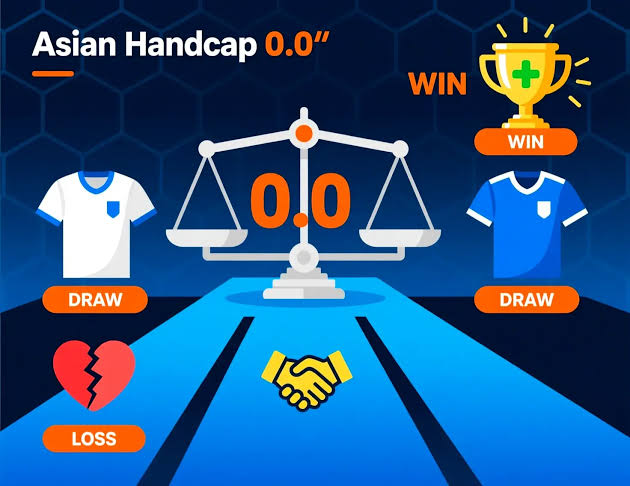
What a Handicap Changes
Handicap betting adjusts the starting position of a team or competitor for settlement purposes. In football, a handicap may require a team to win by a particular number of goals, or it may give that team a virtual advantage before the match is evaluated.
This means that predicting the match winner is not always enough. The final goal difference can determine whether a handicap selection wins, loses, or receives a partial settlement.
Understanding a Negative Handicap
A negative handicap places a virtual disadvantage on the selected team. For example, a team listed at -1 must generally win by at least two goals for a standard -1 handicap bet to win outright under common Asian handicap settlement rules. If the team wins by exactly one goal, the stake is usually returned. If the team draws or loses, the bet loses.
Consider a match in which Team A is selected at -1.
- Team A wins 3-0: the handicap selection wins.
- Team A wins 2-1: the handicap is drawn and the stake is returned.
- Team A draws 1-1: the handicap selection loses.
These examples show why the margin of victory matters.
Understanding a Positive Handicap
A positive handicap gives the selected team a virtual advantage. Suppose Team B is listed at +1.
If Team B wins or draws, the selection wins. If Team B loses by exactly one goal, the result is a push under a standard Asian +1 handicap. If Team B loses by two or more goals, the selection loses.
Quarter-Goal Handicaps
Some Asian handicap markets use quarter-goal lines, such as -0.25 or +0.75. These split the stake between two nearby handicap positions.
For example, a +0.75 handicap divides the stake between +0.5 and +1.0. If the selected team loses by exactly one goal, the +0.5 portion loses while the +1.0 portion is returned. The result is a half-loss.
Quarter-goal lines therefore create more settlement possibilities than a simple win-or-lose market.
Why the Match Winner Is Not Enough
A team may dominate possession and win the match but fail to cover its handicap. A narrow 1-0 victory, for instance, does not satisfy a -1 handicap requiring a two-goal win.
Similarly, an underdog can lose the match but still cover a positive handicap if the defeat remains within the specified margin.
The handicap price reflects expectations about both the result and the margin, although it does not guarantee that either will occur.
Interpreting Handicap Markets Carefully
Before considering any handicap market, it is important to understand the exact line and settlement rules. Different handicap types can treat the same score differently.
Goal difference is the central factor because it connects the final score to the adjusted result. Understanding that relationship helps explain why a match outcome and a handicap outcome are not always the same.

[…] The placement of buttons and information also influences how people navigate a platform. If the account balance is clearly visible, users can more easily monitor their spending. If transaction terms are hidden behind several menus, understanding the consequences of an action becomes more difficult. […]